Second-Hand Stores in Japan
The Complete Guide to Hard Off, 2nd Street, PickUp, and Recycle Shops
LIFE IN JAPAN
1/21/20264 min read
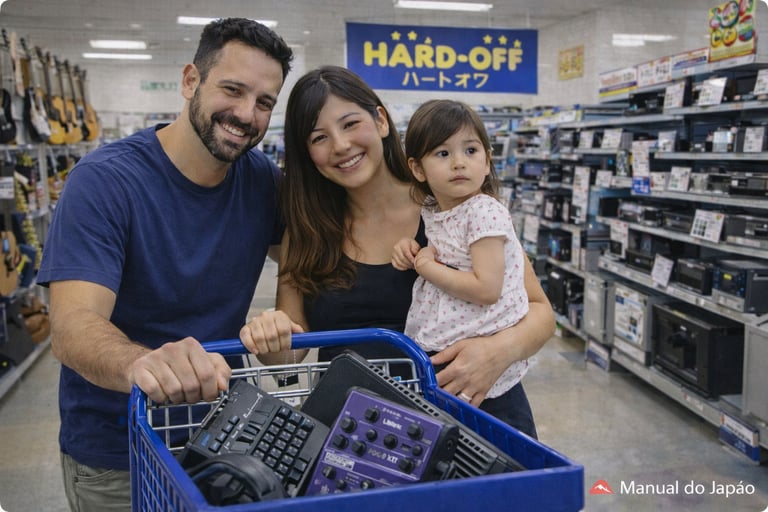
In Japan, buying second-hand items is not a sign of financial difficulty, but rather of intelligence, environmental awareness, and common sense. Second-hand stores (リサイクルショップ - risaikuru shoppu) are a separate universe—organized, clean, and full of real bargains, from a rare video game to a nearly new refrigerator.
This Manual do Japão guide reveals how the main chains work, such as Hard Off, 2nd Street, PickUp, and Mode Off, and teaches you how to navigate them like a veteran, saving thousands of yen in your life in Japan.
The Second-Hand Store Ecosystem: Each with its Specialty
The first rule is: not all second-hand stores are the same. They form an ecosystem with specialized chains. The main ones are from the GEO corporation, famous for Book Off.
Hard Off (ハードオフ): The mecca for electronics, tools, and appliances. Here you can find everything: video games (new and old), TVs, refrigerators, washing machines, vacuum cleaners, guitars, construction tools, and even furniture.
Off House (オフハウス): Hard Off's sister store, focusing on furniture, home goods, dishes, and household utensils. Perfect for furnishing an apartment on a budget.
Mode Off (モードオフ): Specializes in clothes, bags, shoes, and accessories from brands (both Japanese and international). Everything is organized and in great condition.
Hobby Off (ホビーオフ): For collectors. Anime figures (Action Figures), board games, cards (like Pokémon and Yu-Gi-Oh!), model kits (Gunpla), and musical instruments.
2nd Street (セカンドストリート): A major competitor chain that mixes a bit of everything. It has clothing sections (like a thrift store), electronics, furniture, sports gear, and luxury items (like designer bags). Organization can vary more than in the "Off" stores.
PickUp (ピックアップ): A popular chain known for extremely low prices and a huge, diverse inventory. It's a mix of a second-hand store and a "treasure trove warehouse." You can find furniture, appliances, bicycles, tools, sports equipment, and even knick-knacks. The condition of items can vary widely (from "like new" to "needs repair"), but prices are usually the most competitive.
How Buying Works: The Step-by-Step Process
Finding the Store: Use Google Maps. Search for "Hard Off," "2nd Street," "PickUp," or "リサイクルショップ." They are common in commercial areas or industrial warehouses (in the case of PickUp).
Entering and Exploring: The stores are generally well-organized and clean. PickUp may look more like a "packed warehouse," but it's still organized by sections. Feel free to examine the products.
Checking the Condition: ALWAYS check the item's condition. The tags have a classification:
新品 (Shinpin): New, sealed.
未使用 (Mishiyō): Unused, but opened packaging.
美品 (Bihin): In excellent, like-new condition.
中古 (Chūko): Used, but in good condition. May have light signs of use.
ジャンク (Janku): "Junk." Defective or for parts only. Only buy if you know how to repair. PickUp usually has a large janku section with symbolic prices.
Testing (CRUCIAL for electronics): In Hard Off stores, there are outlets available to test appliances and electronics. Bring a power cable or ask a staff member for help. At PickUp, this possibility is less common—buy electrical items at your own risk unless you can test them.
Price and Negotiation: Prices are fixed. PickUp is famous for having colored tags that indicate progressive discounts (e.g., yellow tag = 30% off, red tag = 50% off). Keep an eye out!
Payment and Warranty: They accept card and cash. Hard Off and 2nd Street may offer a short warranty (check the tag). At PickUp, it's usually an "as is" sale.
How to Sell or Trade Your Items (買取 - Kaitori)
These stores also buy your used items. It's a great way to earn extra money before moving.
Hard Off / 2nd Street: More rigorous evaluation, but secure payment. Bring items clean and complete.
PickUp: May accept a wider range of items, even in more used condition, but the offer tends to be lower. It's a good option for disposing of large furniture or appliances you don't want to take to your next home.
Process: A staff member examines the item, tests it, and makes a cash offer on the spot. You can refuse with no obligation.
Smart Buyer's Checklist
Define your goal: For tested electronics with a warranty, go to Hard Off. For cheap furniture, Off House or PickUp. For clothes, Mode Off or 2nd Street.
Bring a bag: Many don't provide plastic bags, or charge for them.
Have AA/AAA batteries: To test controllers and electronic toys.
Use a camera translator app: To read specifications on tags.
At PickUp, check the colored discount tags: That's where the best deals are.
Research new prices online: Before buying used, see how much it costs new on Amazon or Bic Camera to assess if the savings are worth it.
Why Do Japanese People Love Second-Hand Stores?
Culture of "Mottainai" (勿体ない): Aversion to waste. Giving new life to an item is valued.
Strict Quality Control: Broken, dirty, or heavily worn items are simply not accepted for resale.
Organization and Hygiene: Unlike a chaotic thrift store, everything is clean, categorized, and easy to find.
Hidden Treasures: It's possible to find limited editions, discontinued items, and rarities at a fair price.
Circular Economy: PickUp exemplifies this, providing an outlet for a huge variety of items that would otherwise become trash.
Mastering second-hand stores is a superpower for living in Japan. Whether it's to furnish your home at Hard Off, refresh your wardrobe at Mode Off, or hunt for the bargain of the century at PickUp, these establishments are indispensable allies. Next time, instead of going straight to a new store, give a risaikuru shoppu a chance. You might be surprised at what you find—and how much you save in your wallet.
#LojasDeUsadosJapao #HardOff #2ndStreet #PickUp #EconomiaNoJapao #BrasileirosNoJapao #ManualDoJapao #RecycleShop #MobiliarBarato #CompraInteligente #VidaNoJapao #SegundaMaoJapao #PechinchasJapao