Is It Worth Moving to Japan in 2026?
Complete Analysis for Single and Family Brazilians
LIFE IN JAPAN
1/12/20263 min read
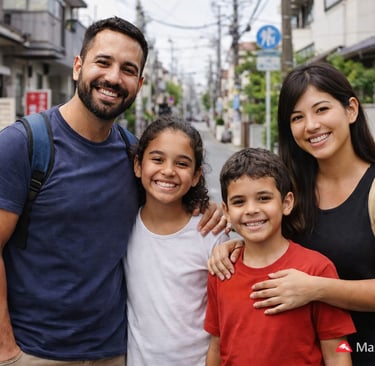
The question about moving to Japan in 2026 demands different answers for different profiles. For a single person, the equation is one. For a family with children, it's another entirely. This Manual do Japão guide analyzes both scenarios in light of new visa rules, the cost of living, and the financial strategies needed to succeed.
The New Scenario: Stricter Rules for Everyone
Whether you are single or have a family, possible changes in immigration policy in 2026 will affect everyone:
Higher Financial Requirement: Visa renewal will require solid proof of financial stability. For singles, an organized account. For families, demonstration of the ability to support all members.
Stability is the Key: Continuous employment history, tax payments on time, and, for families, regular school enrollment of children will be decisive factors.
Focus on Qualification: The safest path for both profiles will be to have a professional specialization valued in the Japanese market.
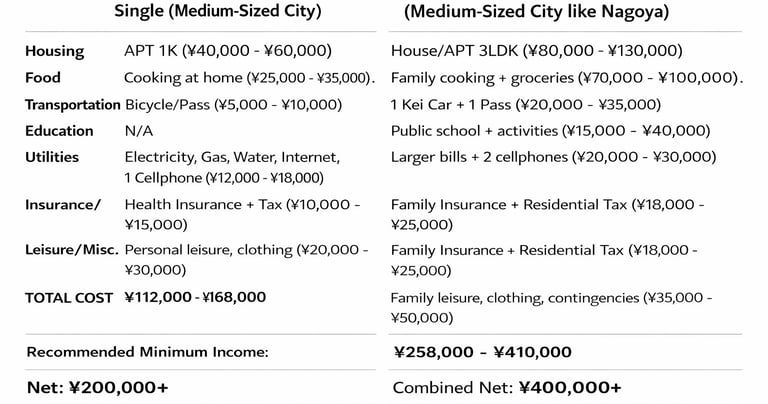
Comparative Financial Analysis: Single vs. Family
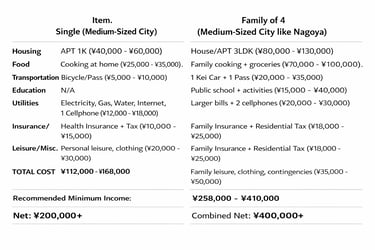
The table below compares the average monthly cost of living in three types of cities for the two profiles. Values for the family consider two working adults and two children in public school.
Analysis by City Type:
Major Metropolises (Tokyo, Osaka): Multiply single costs by ~1.4 and family costs by ~1.3. Access to better jobs, but saving is drastically harder, especially for families.
Medium Cities (Nagoya, Fukuoka): The ideal balance. Better cost-benefit, reasonable job opportunities for couples, and real possibility to save.
Small Towns/Rural Areas: Costs up to 30-40% lower for families. Savings are maximized, but job opportunities for both spouses are the major challenge. For singles, it can be isolating.
Success Strategies for Each Profile
For the Disciplined Single:
Focus on Qualification: Invest in a certificate or skill (e.g., welding, machine operator, Japanese N2) that allows for an above-average salary.
Minimalist Living: Shared housing (share house), own cooking, public transport. Avoid the trap of owning a car unless essential.
Clear Savings Goal: Set a fixed percentage of your salary (e.g., 25%) to be invested or sent to Brazil immediately on payday.
Long-Term Plan: Use the first years to build your resume and savings. Visa renewal in 2026 will reward this stability.
For the Organized Family:
Strategic City Choice: Prioritize medium-sized cities with strong industry or the countryside with municipal incentives (child subsidies). Forget Tokyo if the goal is financial comfort.
Dual Income is Not an Option, it's a Necessity: The move is only sustainable with income from both adults. Confirm job opportunities for the couple before deciding.
Control of School Costs: Take advantage of public schools. Be prepared for extra annual costs (uniforms, trips). Avoid private international schools (cost millions of yen/year).
Support Network is Vital: Settle near a Brazilian community (e.g., Oizumi, Hamamatsu) for support with paperwork, schools, and local information.
Family Remittance Strategy: Treat money to be sent as a "fixed family expense." Accumulate it in a separate account and make monthly transfers via Wise/Remitly to get a good average rate and create forced savings.
The Profiles Likely to Fail in 2026
The Consumerist Single: Spends on sports cars, new iPhone every year, brand clothes, and expensive rent. Lives on the edge and has no margin for the financial proof requirement in visa renewal.
The Single-Income Family: Believes one salary (even high) is enough for four people. Underestimates education, health, and family housing costs. Goes into debt quickly.
Those Who Don't Research Location: Insist on living in Tokyo or Osaka for status, condemning themselves to unsustainable living costs and tiny apartments.
The Currency Speculator: Stops sending money to Brazil for years, waiting for the "perfect" exchange rate moment, and loses out due to yen or real depreciation.
Final Conclusion: The Opportunity Window in 2026
The window to come to Japan in 2026 is still open, but it is narrower and more selective.
For you, single: It is a viable opportunity if you embrace financial discipline from day one, treating the experience as a capital and career building project, not a consumption spree. The country rewards the austere.
For you, family: The move is a high-risk project that can work. It requires meticulous research, the courageous decision to live outside major centers, and the absolute certainty that both will work. The reward is a safe quality of life and a solid education for the children.
Japan in 2026 is no longer the land of quick plenty. It is the land of slow reward, constant work, and relentless organization. Those who fit this profile, whether single or family, will still find a possible future here.
#LivingInJapan2026 #BraziliansInJapan #CostOfLivingJapan #JapanVisa #SingleInJapan #FamilyInJapan #Nagoya #JapaneseCountryside #FinancialPlanning #ManualDoJapao #EconomyInJapan